Council Meeting – 17th December 1896
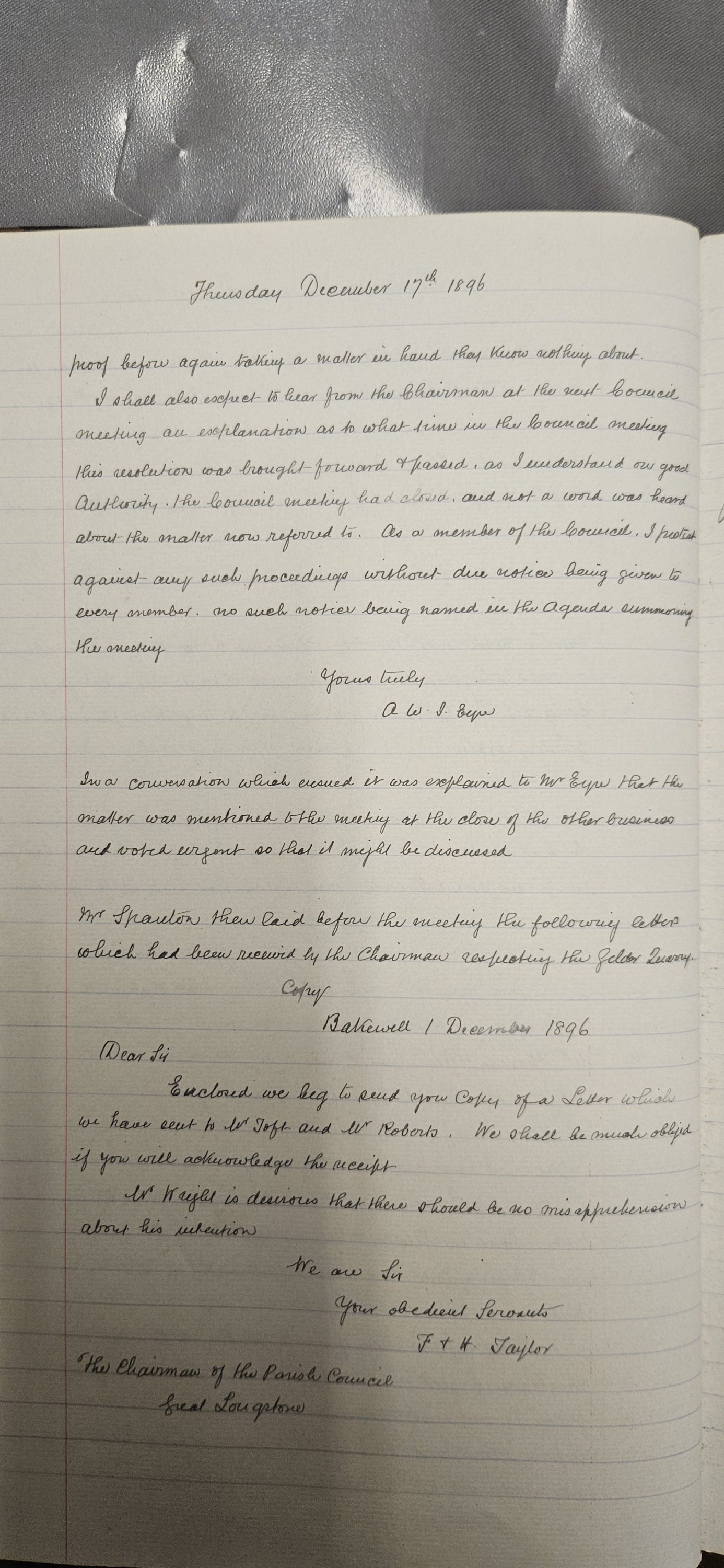
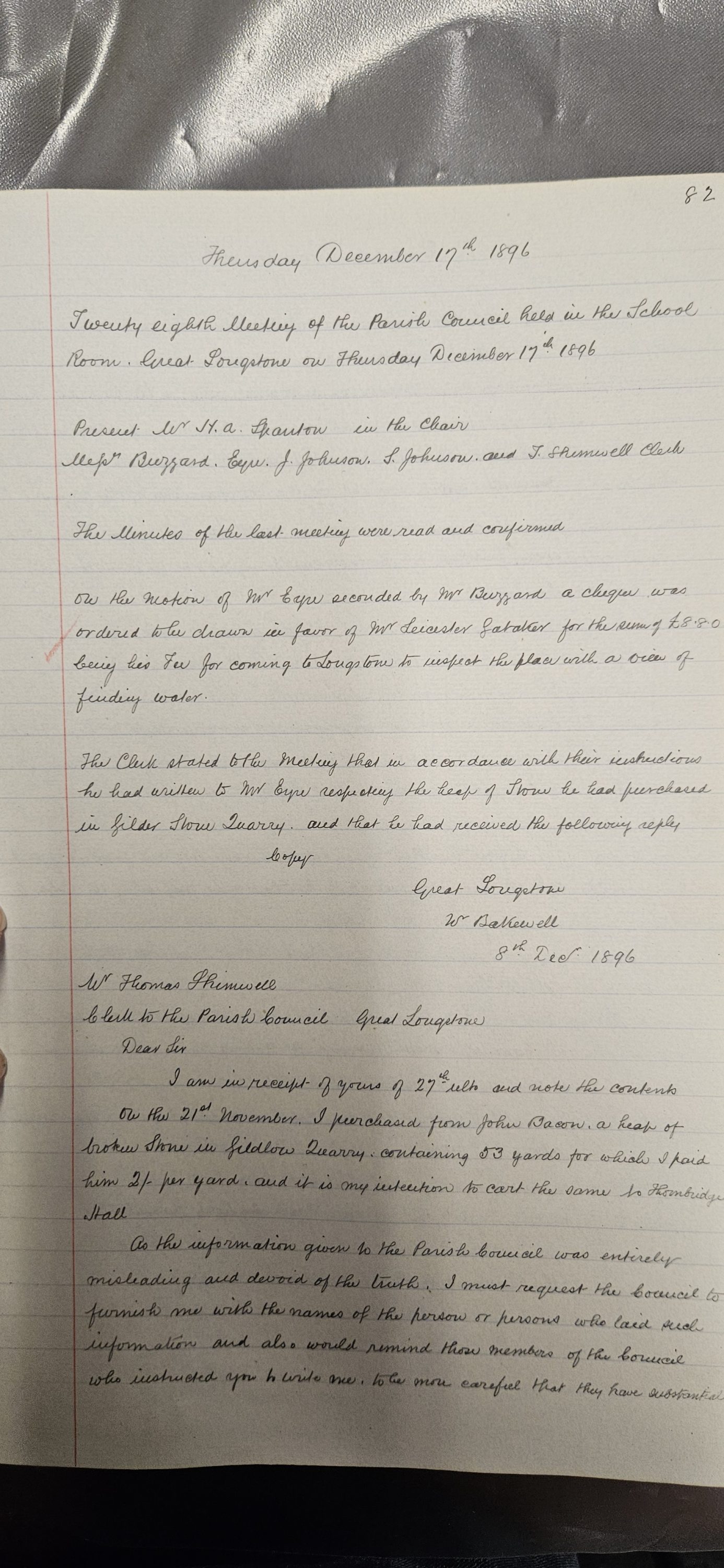
Thursday, December 17th, 1896
Twenty-eighth meeting of the Parish Council held in the School Room, Great Longstone, on Thursday, December 17th, 1896.
Present: Mr H. A. Spanton in the Chair; Messrs Buzzard, Eyre, J. Johnson, S. Johnson, and T. Shimwell, Clerk.
The minutes of the last meeting were read and confirmed.
On the motion of Mr Eyre, seconded by Mr Buzzard, a cheque was ordered to be drawn in favour of Mr Leicester Bataker for the sum of £8. 8. 0., being his fee for coming to Longstone to inspect the place with a view of finding water.
The Clerk stated to the meeting that, in accordance with their instructions, he had written to Mr Eyre respecting the heap of stone he had purchased in Gilders Stone Quarry, and that he had received the following reply:
Copy
Great Longstone, nr Bakewell
8th Dec. 1896
Mr Thomas Shimwell,
Clerk to the Parish Council, Great Longstone.
Dear Sir,
I am in receipt of yours of 27th ult. and note the contents.
On the 27th November I purchased from John Bacon a heap of broken stone in Gilders Quarry containing 53 yards for which I paid him 2/- per yard, and it is my intention to cart the same to Thornbridge Hall.
As the information given to the Parish Council was entirely misleading and devoid of truth, I must request the Council to furnish me with the name of the person or persons who laid such information, and also would remind those members of the Council who instructed you to write me to be more careful that they have substantial proof before again taking a matter in hand they know nothing about.
I shall also expect to hear from the Chairman at the next Council meeting an explanation as to what time in the Council meeting this resolution was brought forward and passed, as I understand on good authority the Council meeting had closed, and not a word was heard about the matter now referred to. As a member of the Council I protest against any such proceedings without due notice being given to every member, no such notice being named in the Agenda summoning the meeting.
Yours truly,
A. W. J. Eyre
In a conversation which ensued it was explained to Mr Eyre that the matter was mentioned to the meeting at the close of the other business and voted urgent, so that it might be discussed.
Mr Spanton then laid before the meeting the following letter which had been received by the Chairman respecting the Gilders Quarry:
Copy
Bakewell, 1 December 1896
Dear Sir,
Enclosed we beg to send you copy of a letter which we have sent to Mr Toft and Mr Roberts. We shall be much obliged if you will acknowledge the receipt.
Mr Wright is desirous that there should be no misapprehension about his intentions.
We are Sir,
Your obedient Servants,
F. & H. Taylor
To the Chairman of the Parish Council,
Great Longstone.
Copy
Bakewell, 27 November 1896
Dear Sir,
Gilders Quarry
In October 1895 Mr Wright issued a circular letter and notice in which he expressed his intentions to keep the removal of stone on his estate under his own control, and at his request we addressed a letter to the Parish Council of Longstone dated 20 February 1896, in which we directed attention to the fact that “Gilders Quarry” is old enclosure belonging to his Longstone Hall estates, and subject to no Parish rights like the neighbouring “Gilder Quarry,” which is Parish property.
No reply of any kind in opposition to those letters has been made, but several gentlemen have seen and expressed themselves satisfied from examination of the old maps and papers that the “Gilders Quarry” has no connection (except in similarity of name) with the “Gilder Quarry” belonging to the Parish.
We are now instructed to give you formal notice that the Gilders Stone Quarry, which is situated on the east and right-hand side of the ascent to Longstone Moor by Hillside Road, and all stone in it (gotten or ungotten) is the property of the Longstone Hall estate, and that a small acknowledgment or toll will be enforced in respect of all stone taken from the said quarry on and after the 1st day of January 1897, after which date no stone may be removed except after measurement and by the written consent of W. A. or J. G. Eyre of Great Longstone or the proprietor.
Out of consideration for those who prefer to get stone in this Gilders Quarry in preference to the Parish Quarry at Gilder, no difficulty will be made by the present proprietor so long as his rights are respected and duly recognised.
Yours truly,
F. & H. Taylor
Mr Albert Toft,
Surveyor of Roads.
After the foregoing letters had been read and discussed, it was proposed by Mr S. Johnson and seconded by Mr J. Johnson that a public meeting be called to test the feeling of the Parish on the subject, more especially with a view to get an expression of opinion from the ratepayers whether the Parish Council should withstand Mr Wright in his pretensions to claim the Parish Quarry as his property.
All voted for the proposition except Mr Eyre, who remained neutral.
It was then decided to hold the Public Meeting on Monday the 28th inst. at 7 o’clock in the School Room.
The Clerk was directed to obtain tenders for the supply of the Dob Meadows for consideration at their next meeting.
James Orr
Chairman
Jan. 8th, 1897
Historical Context – Rights and the Land
The dispute over Gilder and Gilders Stone Quarries reflects a wider pattern of rural change in the late 19th century. Across England, newly formed parish councils were asserting long-overlooked communal rights over greens, lanes, and quarries. These cases often brought them into conflict with private estate owners, as at Great Longstone. The eventual confirmation of the Parish Council’s ownership of the quarry was part of a national story — local communities reclaiming responsibility for the spaces that shaped their daily lives.