Council Meeting – 29th June 1905
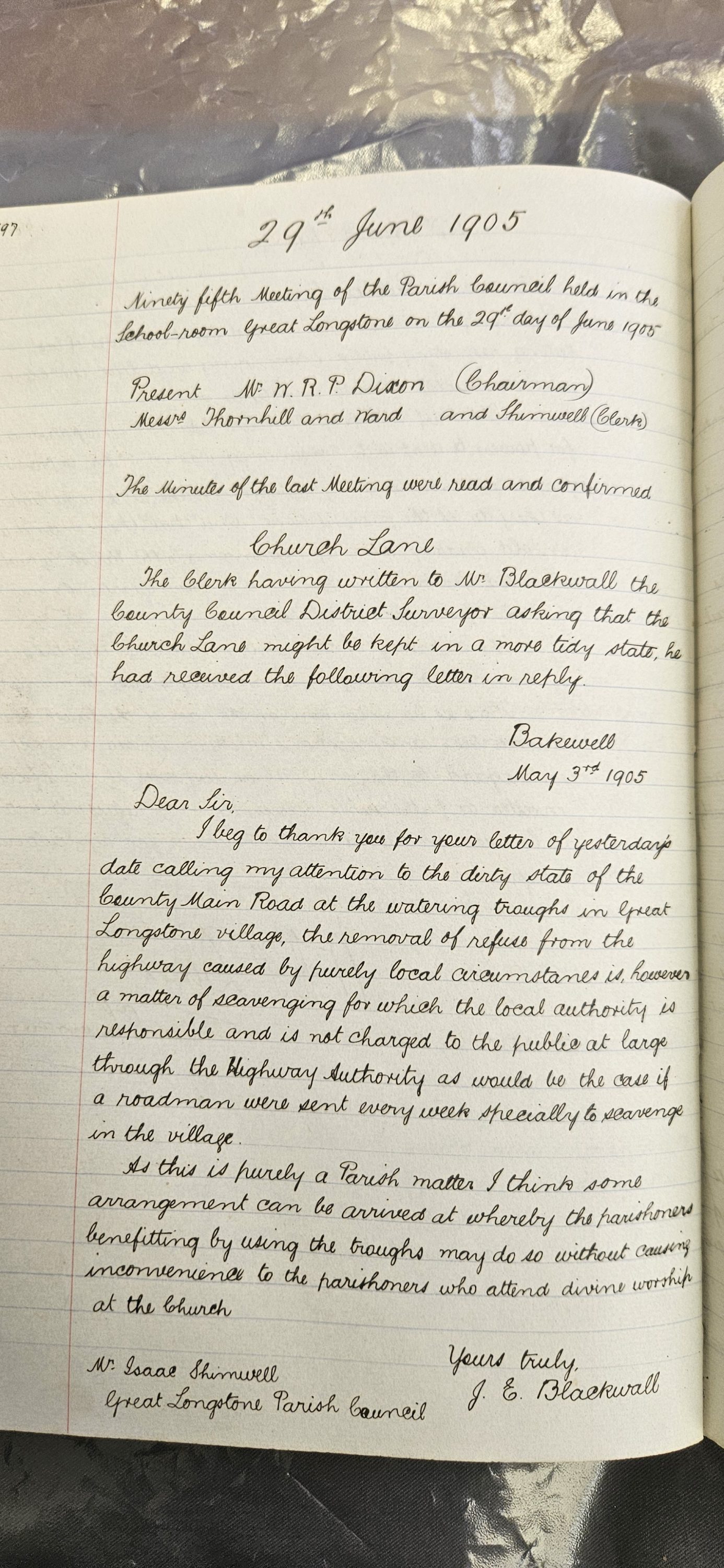
Ninety fifth Meeting of the Parish Council held
in the School-room Great Longstone
on the 29th day of June 1905.
Present
Mr W. R. P. Dixon (Chairman)
Messrs Thornhill and Ward and Shimwell (Clerk)
The Minutes of the last Meeting were read and confirmed.
Church Lane
The Clerk having written to Mr Blackwall the County Council District Surveyor asking that the Church Lane might be kept in a more tidy state, he had received the following letter in reply.
Bakewell
May 3rd 1905
Dear Sir,
I beg to thank you for your letter of yesterday’s date calling my attention to the dirty state of the County Main Road at the watering troughs in Great Longstone village, the removal of refuse from the highway caused by purely local circumstances is however a matter of scavenging for which the local authority is responsible and is not charged to the public at large through the Highway Authority as would be the case if a roadman were sent every week specially to scavenge in the village.
As this is purely a Parish matter I think some arrangement can be arrived at whereby the parishioners benefitting by using the troughs may do so without causing inconvenience to the parishioners who attend divine worship at the church.
Yours truly,
J. E. Blackwall
Mr Isaac Shimwell
Great Longstone Parish Council
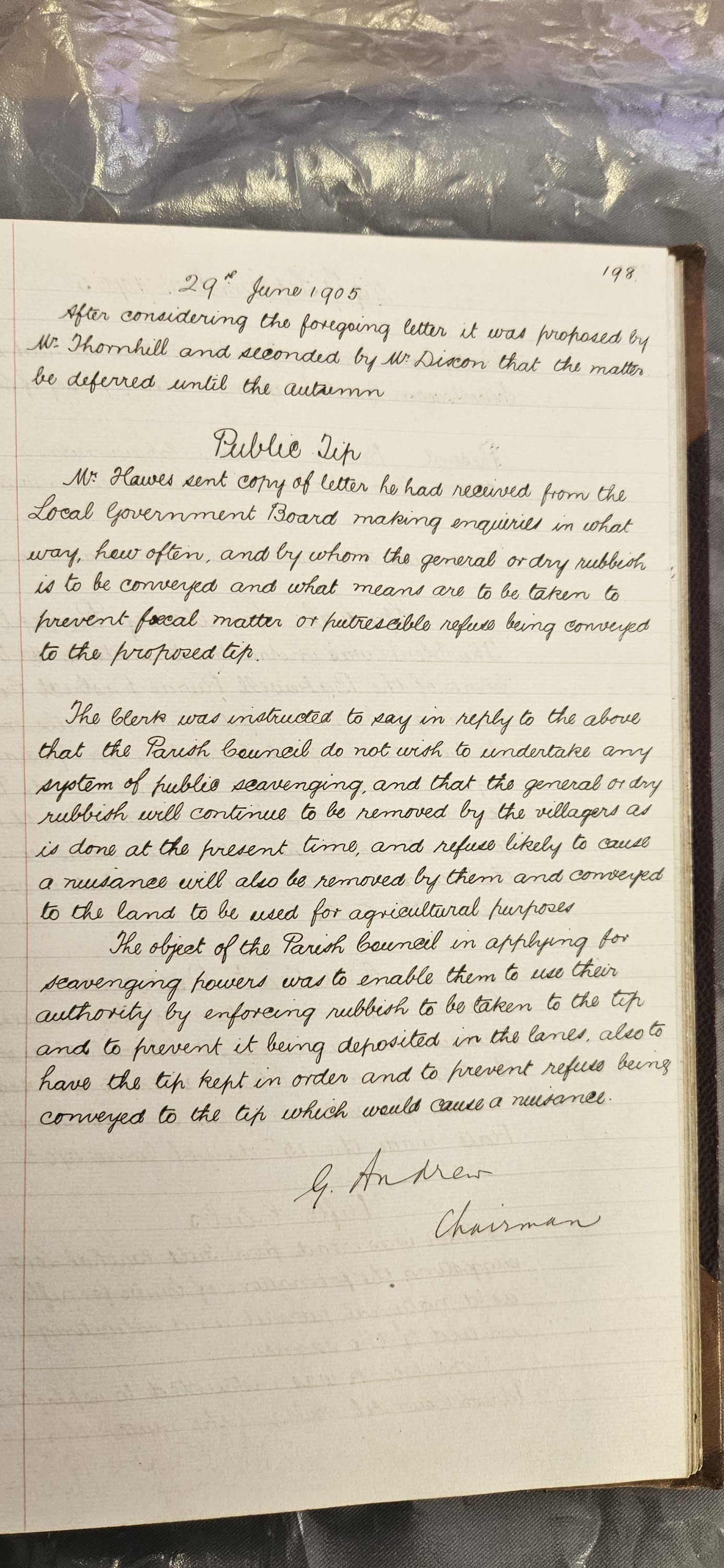
After considering the foregoing letter it was proposed by Mr Thornhill and seconded by Mr Dixon that the matter be deferred until the autumn.
Public Tip
Mr Hawes sent copy of letter he had received from the Local Government Board making enquiries in what way, how often, and by whom the general or dry rubbish is to be conveyed and what means are to be taken to prevent fæcal matter or putrescible refuse being conveyed to the proposed tip.
The Clerk was instructed to say in reply to the above that the Parish Council do not wish to undertake any system of public scavenging, and that the general or dry rubbish will continue to be removed by the villagers as is done at the present time, and refuse likely to cause a nuisance will also be removed by them and conveyed to the land to be used for agricultural purposes.
The object of the Parish Council in applying for scavenging powers was to enable them to use their authority by enforcing rubbish to be taken to the tip and to prevent it being deposited in the lanes, also to have the tip kept in order and to prevent refuse being conveyed to the tip which would cause a nuisance.
G. Andrew
Chairman