Washing Ore in Longstone
It has been suggested from time to time that lead ore was brought to the village of Great Longstone for washing and whilst it is quite possible that this may have been the case, it is advisable to consider what evidence is available in support of the theory.
DERBYSHIRE MISCELLANY
The Bulletin
of
The Local History Section
of the
Derbyshire Archaeological and Natural History Society
Number 6[1] June 1957 – Page 76
Washing Ore in Longstone
by Robert Thornhill
It has been suggested from time to time that lead ore was brought to the village of Great Longstone for washing and whilst it is quite possible that this may have been the case, it is advisable to consider what evidence is available in support of the theory.
The story may have been passed down from the miners of old as many descendants live in the village but first it may be best to consider the way in which ore was washed.
Some interesting notes on lead mining are given by Brey in his “Sketch of a Tour into Derbyshire and Yorkshire” the second edition of which published in 1783. On page220 he states:
“The lead ore, when brought out of, the mine, is broken with heavy hammers on a stone, called a knock-stone, and is then put into a wooden sieve, and rinsed in a large tub; the ore falls through, and leaves the lighter rubbish, which is skimmed off, thrown out at a hole in the wall, and thence taken to the buddle, where it is rinsed again by a small current of water, the lead falling to the bottom. What is carried down by the current, is washed once more in the same manner, and the deposit here, which is, almost as fine as flour, is called belland. The beating and first rinsing is done by women, who work nine hours in the day, and earn about seven-pence. The men earn about eight shillings a week.”[2]
Dealing with the evidence:-
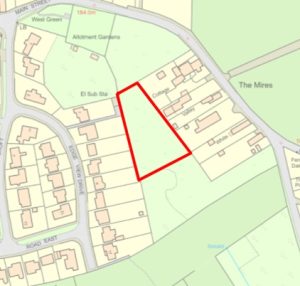
- The washing is supposed to have taken place in a small field of about half an acre, in the Mires in the lower end of the village. The field is No, 476 on the 1898 Ordnance map and No.184, in the Enclosure Award of 1824, when it was part of the allotment to Edward Buxton.

- The land is always spoken of as being “belland” and animals on it for any length of time are likely to die as a result of lead poisoning. The presence of lead can only be due to it having been brought there, as the nearest lead workings or rake is over half a mile away.
- A story is told of water being taken to the mines for ore washing and of the donkey boy considering that he should receive more pay. Donkeys with panniers were used and no doubt water would be obtained from one of the two village pumps. It is probable that the same donkeys may have been used to bring finely crushed material to the village for separation in what would be the nearest running water.
- The suggested washing site is on level ground and there are no signs of any heaps of discarded material. On the other hand it is unlikely that any large volume of material would be conveyed to the washing site, which presumably was only used for the separation of fine material which had to be dealt with in running water. Traces of fluor gravel, also lead ore, have been found in the area so waste material may have been spread on the ground near to the washing place. It is reported that soil was afterwards spread over it.
- For some years the surrounding area has been very wet due to a drain which runs underneath having been blocked. The drain was the original village sewer but since a new sewerage scheme was complete seme 25 years ago, the old drain has been used mainly for surface water from the roads. To the drain are connected the overflows from several wells and springs so there is a constant but small flow of water always passing through it.
- The stone lined drain or sewer follows the main road as far as a bend in the lower part of the village and then crosses four small fields to the sewerage works which were constructed in two former willow beds. In 1859 these beds were described as “Fishpond and Willow Piece” and no doubt at that time, or a little earlier, only spring and storm water would run into them.
- Until the early part of the present century, when it was piped, the “drain” across the first field was for about 60 yards in the form of an open ditch. The remainder is stone built in three sections of approximately 90, 60 and 90 yards in length. The two 90 yard lengths are built to form rectangular drains about 15″ by 15″ with stone covers but the 60 yard length is the centre is of particular interest in view of what was found when it was opened for for cleaning in 1956.
- It was at this time that the discovery was made regarding the three sections and that the centre one had been built with sloping sides, that it was about 24″ wide at the top and 18″ at the bottom. The depth was roughly 13″ and very large cover stones had been fitted. As a drain there is no reason why this section should be any different from the others but as a washing place the construction appears to be admirable.
- The dimensions given are approximate as it was unfortunately not possible to make a very detailed examination during the time when the drain was being cleaned out but the information obtained was sufficient, however, to confirm the theory regarding washing ore in the village and Longstone can claim to possess a very fine BUDDLE although it is not on show.
Acknowledgements:
[1] This article was written by the noted Longstone Historian “Robert Thornhill” and was published by the Derbyshire Archaeological and Natural History Society in the June 1957 edition of “Derbyshire Miscellany (See page 76). https://www.derbyshireas.org.uk/DM01-06.pdf
[2] Sketch of a tour into Derbyshire and Yorkshire, By William Bray, published in 1783 (pages 220-221) https://archive.org/details/bim_eighteenth-century_sketch-of-a-tour-into-de_bray-william_1783/page/n239/mode/2up