Joint Meeting between the Parish Council and Bakewell Rural District Council on 24th July 1895
Great Longstone Parish Council
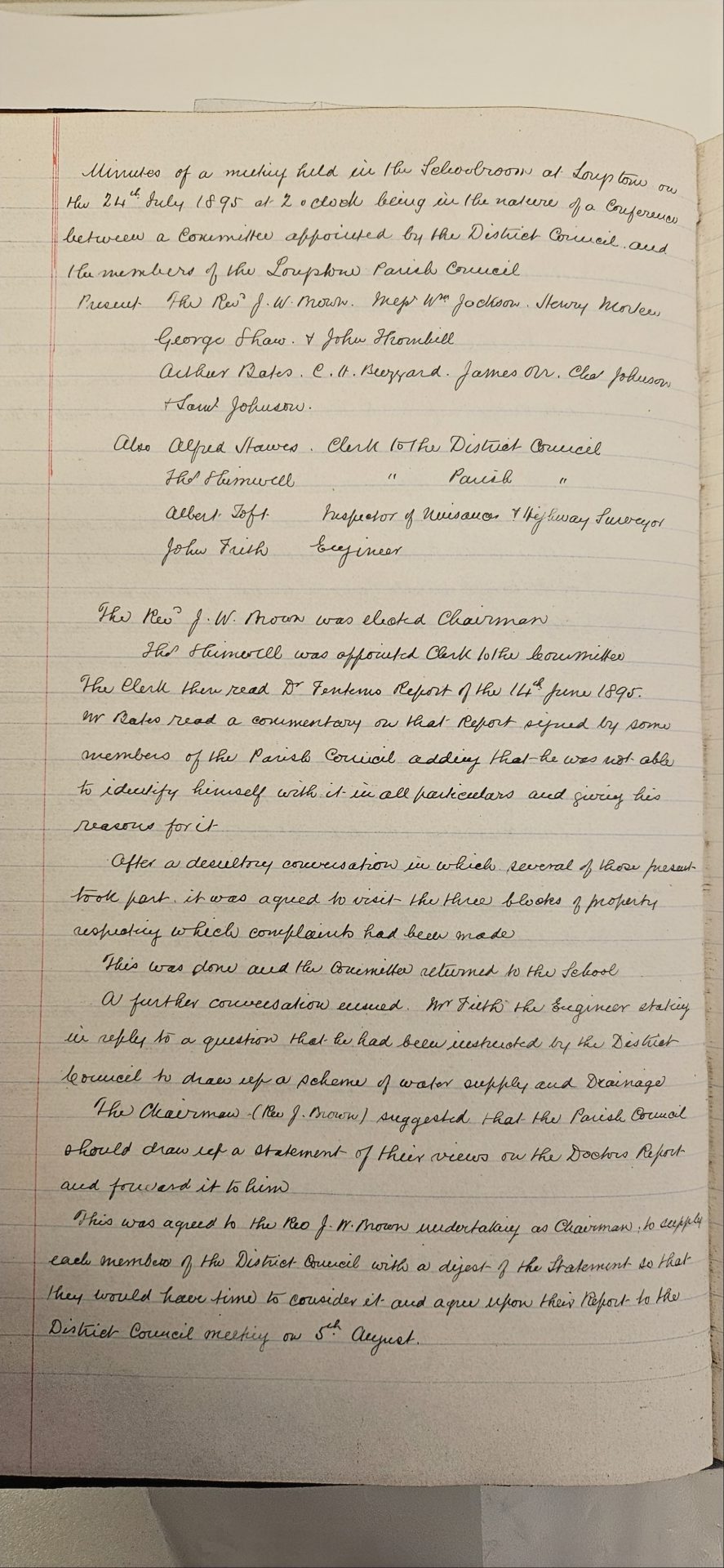
Minutes of a Joint Committee Meeting
Held in the School Room, Great Longstone — 24 July 1895, 2 p.m.
(As recorded in the Parish Council Minute Book, folios 31–37)
Present:
The Rev. J. W. Brown, Messrs. Wm. Jackson, Henry Morton, George Shaw, and John Thornhill (District Council Committee).
Arthur Bates, C. H. Buzzard, James Orr, Sam Johnson (Parish Council).
Also present:
Alfred Hawes, Clerk to the District Council;
Thos. Shimwell, Clerk to the Parish Council;
Albert Toft, Inspector of Nuisances and Highway Surveyor;
John Faith, Engineer.
The Rev. J. W. Brown was elected Chairman.
Thos. Shimwell was appointed Clerk to the Committee.
The Clerk then read Dr. Fenton’s Report of the 14th June 1895.
Mr. Bates read a commentary on that Report, signed by some members of the Parish Council, adding that he was not able to identify himself with it in all particulars and giving his reasons for it.
After a desultory conversation, in which several of those present took part, it was agreed to visit the three blocks of property respecting which complaints had been made.
This was done, and the Committee returned to the School Room.
A further conversation ensued. Mr. Faith, the Engineer, stated in reply to a question that he had been instructed by the District Council to draw up a scheme of water supply and drainage.
The Chairman (Rev. J. W. Brown) suggested that the Parish Council should draw up a statement of their views on the Doctor’s Report and forward it to him.
This was agreed to. The Rev. J. W. Brown undertook, as Chairman, to supply each member of the District Council with a digest of the statement, so that they would have time to consider it and agree upon their report to the District Council meeting on 5th August.
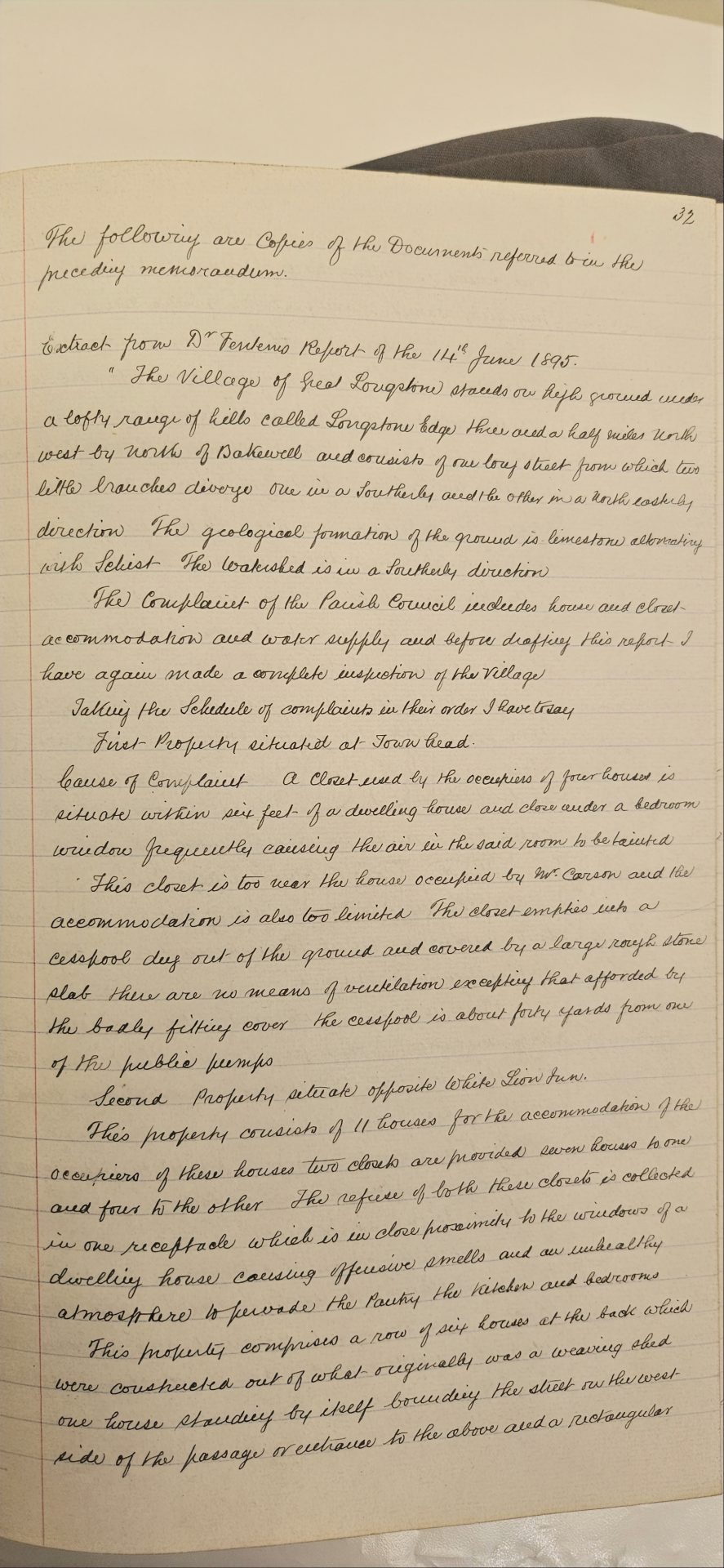
Extract from Dr. Fenton’s Report
Dated 14 June 1895
“The village of Great Longstone stands on high ground under a lofty range of hills called Longstone Edge, three and a half miles north-west by north of Bakewell, and consists of one long street from which two little branches diverge — one in a southerly, and the other in a north-easterly direction. The geological formation of the ground is limestone alternating with schist. The watershed is in a southerly direction.
The complaint of the Parish Council includes houses and closet accommodation and water supply, and before drafting this report I have again made a complete inspection of the village.
Taking the Schedule of complaints in their order I have to say —
First Property — Situated at Town Head
Cause of complaint:
A closet used by the occupiers of four houses is situated within six feet of a dwelling house and close under a bedroom window, frequently causing the air in the said room to be tainted. This closet is too near the houses occupied by Mr. Carson and the accommodation is also too limited. The closet empties into a cesspool dug out of the ground and covered by a large rough stone slab. There are no means of ventilation excepting that afforded by the badly fitting cover. The cesspool is about forty yards from one of the public pumps.
Second Property — Situated opposite the “White Lion”
This property consists of 11 houses for the accommodation of the occupiers of these houses. Two closets are provided, seven houses to one and four to the other. The refuse of both these closets is collected in one receptacle which is in close proximity to the windows of a dwelling house, causing offensive smells and an unhealthy atmosphere to pervade the pantry, the kitchen, and bedrooms.
This property comprises a row of six houses at the back which were constructed out of what originally was a weaving shed, one house standing by itself, bounding the street on the west side of the passage or entrance to the above and a rectangular block of five houses, three of which are inhabited and two empty. These houses are situated on the opposite side of the passage to the row previously named, making a total of twelve houses.
There are two closets of the old-fashioned midden type for all these houses, the midden which is enclosed and which receives most of the slop water from the six houses at the back being about a yard from the corner of the detached house and within a few feet of the first of the houses in the rectangular block. The only means of access to the row of six houses is through an opening between the corner house and this privy midden. The proximity between these houses and the closet receptacles, as well as the approach to the row of six houses, is shown in the accompanying photograph.
Opposite this row of six houses and 18 feet from the front of them is a rubble-stone catch-basin into which some of the slops are emptied, whilst others are deposited in the closet lots at the bottom of the steps. The effluvium from this open catch-basin, in warm weather especially, is most objectionable.
Third Property — Situated in Mill Lane
One closet used by the tenants of five houses is situated close to the pump from which the water used for drinking purposes in these houses is obtained.
There are two closets and not one, as asserted, for the accommodation of these five houses. The privy midden is within six feet of the pump which has been fixed for the supply of these houses.
Requirements necessary to meet the deficiencies of the properties complained of are as follows:
First — Townhead Property:
Two properly constructed privies, as described in my report to your authority dated September 8th, 1894, should be erected on a convenient site in the piece of ground now used as a garden and as far removed as possible from the houses.
Second — Property opposite “White Lion”:
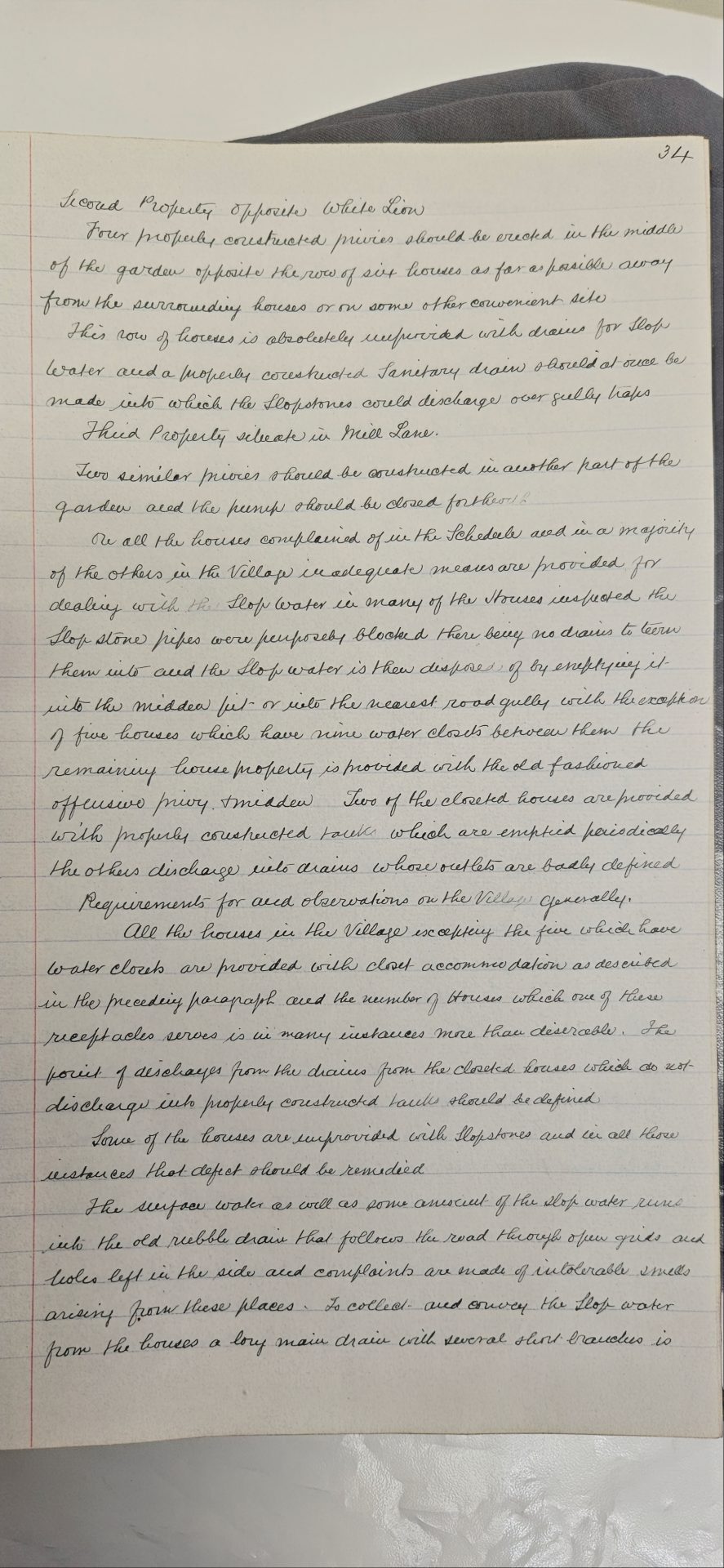
Four properly constructed privies should be erected in the middle of the garden opposite the row of six houses, as far as possible away from the surrounding houses, or on some other convenient site.
This row of houses is absolutely unprovided with drains for slop water, and a properly constructed sanitary drain should at once be made into which the slop stones could discharge over gully traps.
Third — Property situated in Mill Lane:
Two similar privies should be constructed in another part of the garden, and the pump should be closed forthwith.
On all the houses complained of in the Schedule, and in a majority of the others in the village, inadequate means are provided for dealing with the slop water. In many of the houses, indeed, the slop stone pipes are untrapped, blocks of them being no drains to turn them into, and the slop water is then disposed of by emptying it into the midden pit or into the nearest road gully. With the exception of five houses which have nine water closets between them, the remaining house property is provided with the old-fashioned offensive privy midden. Two of the isolated houses are provided with properly constructed tanks which are emptied periodically, the others discharge into drains whose outlets are badly defined.
Requirements for and Observations on the Village Generally
All the houses in the village, excepting the five which have water closets, are provided with closet accommodation as described in the preceding paragraph, and the number of houses which one of these receptacles serves is in many instances more than desirable. The point of discharge from the drains from the closet houses which do not discharge into properly constructed tanks should be defined.
Some of the houses are unprovided with slop stones, and in all those instances that defect should be remedied.
The surface water, as well as some amount of the slop water, runs into the old rubble drain that follows the road through open grilles and holes left in the side, and complaints are made of intolerable smells arising from these places. To collect and convey the slop water from the houses, a long main drain with several short branches is required.
Proposed Main Drainage
This drain should be as follows:
A sanitary main drain should commence in the Dale and run down Gilder’s Scavry Lane, north from opposite the pump at the Town Head, a junction with a short length of about 60 yards coming from the direction of Little Longstone. It would then pass down the whole length of the village, receiving in its course opposite the Crispin Inn a short length of 34 yards and a length of about 160 yards from the Mill Lane direction which would join the main just below the Village Cross. Another short branch of about 9 yards is required to drain the property situated in Church Lane.
From the bottom of Church Lane, the main would pass directly down the Village Street, receiving short lateral branches from the property on either side, to the outfall. The outfall below the Meirs would then be a convenient site for having the sewerage dealt with and disposed of.
The total length of drain required — main and branches to which should be constructed — is upwards of ½ mile in length.
I have requested Mr. Toft to prepare a rough plan of this drainage, in some measure to verify my measurements; but I find it does not include the length from Mr. Albert Wayne’s to the Dales, which must be added to make it complete.
At present only two houses would discharge their water closets into this main; the remainder of the sewerage consisting of slop and surface water, so that it might be dealt with at the outfall by lateral filtration and river beds. If, however, the number of water closets increased, other means of dealing with the sewerage would have to be adopted.
Analysis of Water from Pumps
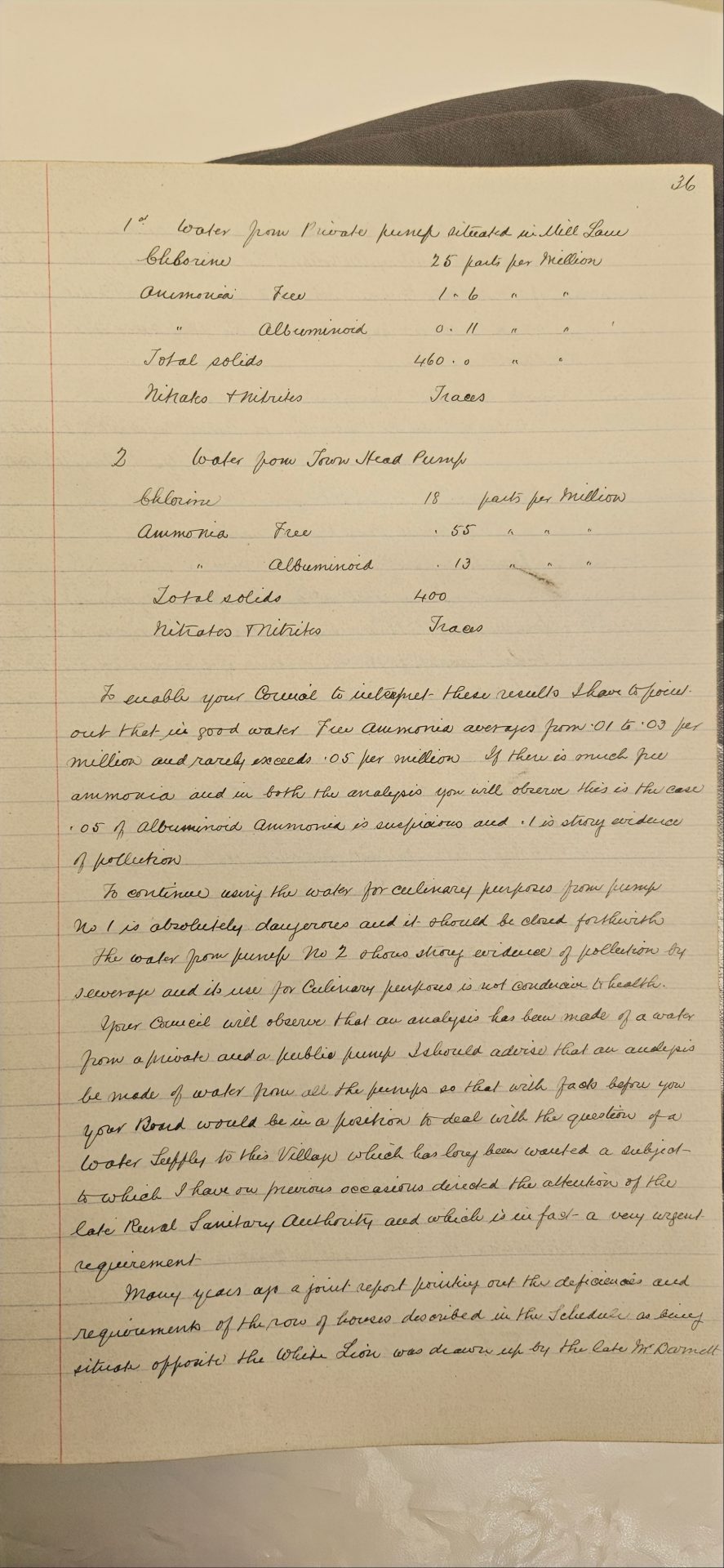
As one of the properties complained of, viz. that situated in Mill Lane, my attention is directed to the proximity of the pump to the privy. An analysis of the water from this pump has been made, as well as an analysis of the water from the public pump at the Town Head, which is the one I have in an earlier part of my report directed your attention to as being about 40 yards from a badly constructed cesspool.
The result of the analysis is as follows:
1. Water from Private Pump situated in Mill Lane
Chlorine – 25 parts per million
Ammonia (Free) – 1.6 per million
Ammonia (Albuminoid) – 0.11 per million
Total solids – 460.0 per million
Nitrates/Nitrites – Traces
2. Water from Town Head Pump
Chlorine – 18 parts per million
Ammonia (Free) – 0.55 per million
Ammonia (Albuminoid) – 0.13 per million
Total solids – 400 per million
Nitrates/Nitrites – Traces
Observations on Analysis
To enable your Council to interpret these results, I have to point out that in good water, free ammonia averages from 0.016 to 0.03 per million and rarely exceeds 0.05 per million. If there is much free ammonia, and in both the analyses you will observe this is the case, 0.05 of albuminoid ammonia is suspicious and 1.0 is strong evidence of pollution.
To continue using this water for culinary purposes from pump No. 1 is absolutely dangerous and it should be closed forthwith. The water from pump No. 2 shows strong evidence of pollution by sewerage, and its use for culinary purposes is not conducive to health.
Your Council will observe that an analysis has been made of a water from a private and a public pump. I should advise that an analysis be made of water from all the pumps so that with full facts before you your Board would be in a position to deal with the question of a water supply to this village, which has long been wanted — a subject to which I have on previous occasions directed the attention of the late Rural Sanitary Authority, and which is in fact a very urgent requirement.
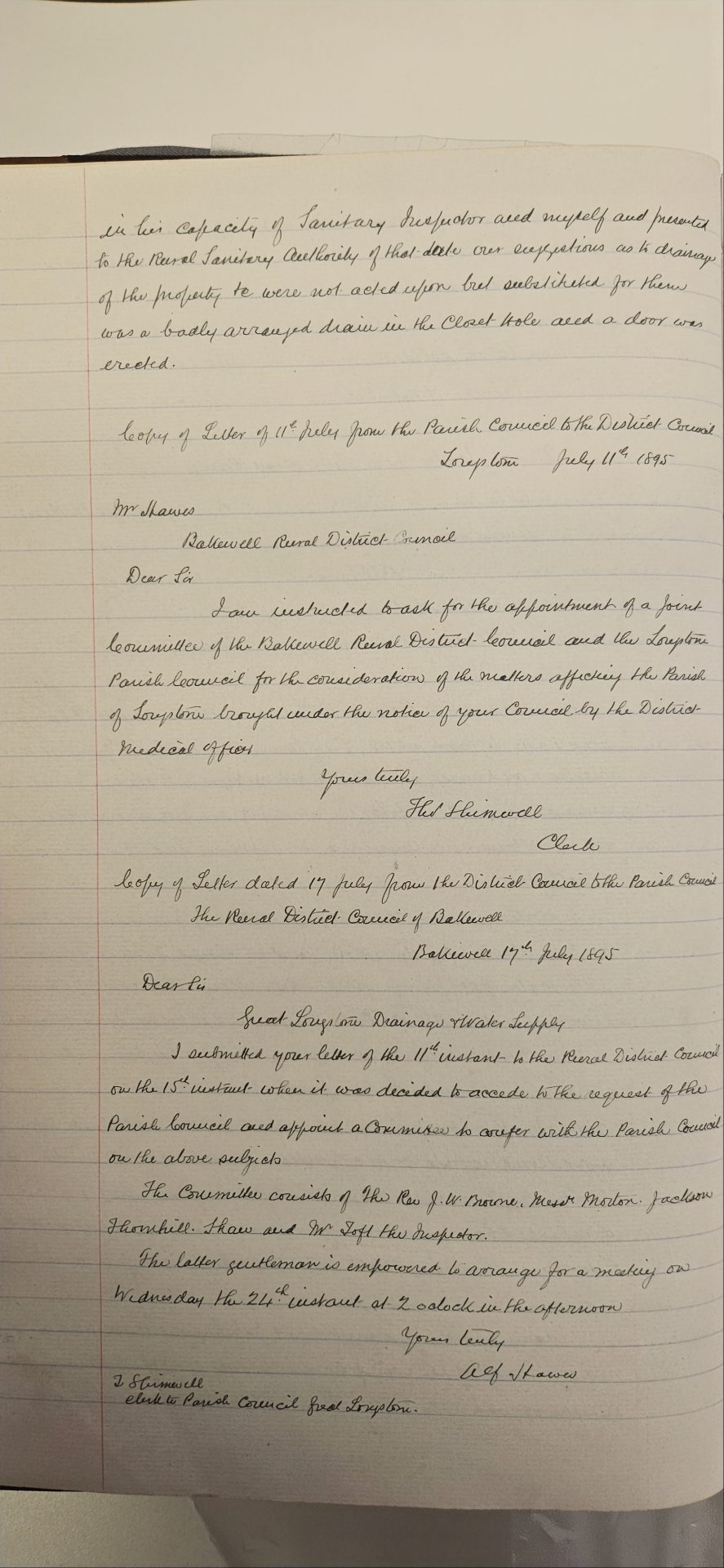
Many years ago a joint report, pointing out the deficiencies and requirements of the row of houses described in the Schedule as being situated opposite the “White Lion,” was drawn up by the late Mr. Marriott in his capacity of Sanitary Inspector, and myself, and presented to the Rural Sanitary Authority of that date. Our suggestions as to drainage of the property were not acted upon, but substituted for them was a badly arranged drain in the closet hole, and a door was erected.
Correspondence
Letter from Parish Council to the District Council
Longstone, July 11th, 1895
To: Mr. Hawes,
Bakewell Rural District Council
Dear Sir,
I am instructed to ask for the appointment of a Joint Committee of the Bakewell Rural District Council and the Longstone Parish Council for the consideration of the matters affecting the Parish of Longstone brought under the notice of your Council by the District Medical Officer.
Yours truly,
Thos. Shimwell,
Clerk.
Reply from the District Council to the Parish Council
Bakewell, 17th July 1895
Dear Sir,
Great Longstone Drainage & Water Supply
I submit your letter of the 11th instant to the Rural District Council on the 15th instant, when it was decided to accede to the request of the Parish Council and appoint a Committee to confer with the Parish Council on the above subjects.
The Committee consists of the Rev. J. W. Brown, Messrs. Morton, Jackson, Thornhill, Shaw, and Mr. Toft, the Inspector.
The latter gentleman is empowered to arrange for a meeting on Wednesday, the 24th instant, at 2 o’clock in the afternoon.
Yours truly,
Alf. Hawes,
Clerk,
Rural District Council of Bakewell.
To: Thos. Shimwell,
Clerk to the Parish Council of Great Longstone.